In this article
Insurance selalu masuk the “later” list. We get it. You’re young, you’re healthy, you’ve got a car loan, maybe a house, maybe a baby on the way, and the last thing you want to think about over breakfast is what happens if you don’t come home one day. But stay with me for ten minutes, because this is probably the most important money topic worth talking about with the people who depend on you.
The awkward question nobody asks at kenduri
Picture Faizal. He’s 35, works in Shah Alam, earns about RM6,000 a month. Wife works part time, two kids in primary school, a terrace house with a 30 year loan, and a Myvi that still has four years to go. Normal life lah. Nothing fancy.
Now imagine one Tuesday he gets into an accident on the Federal Highway. Touch wood. What happens to that household the following month?
The salary stops. Straight away. The bank still wants its instalment. The school still wants its fees. The groceries, the electric bill, the car, the tuition, all of it keeps coming. And Faizal, like a lot of us, had been telling himself he would “sort out insurance later”.
Faizal is made up. But the bills in his story will be very familiar to a lot of households.
Where Malaysians stand today
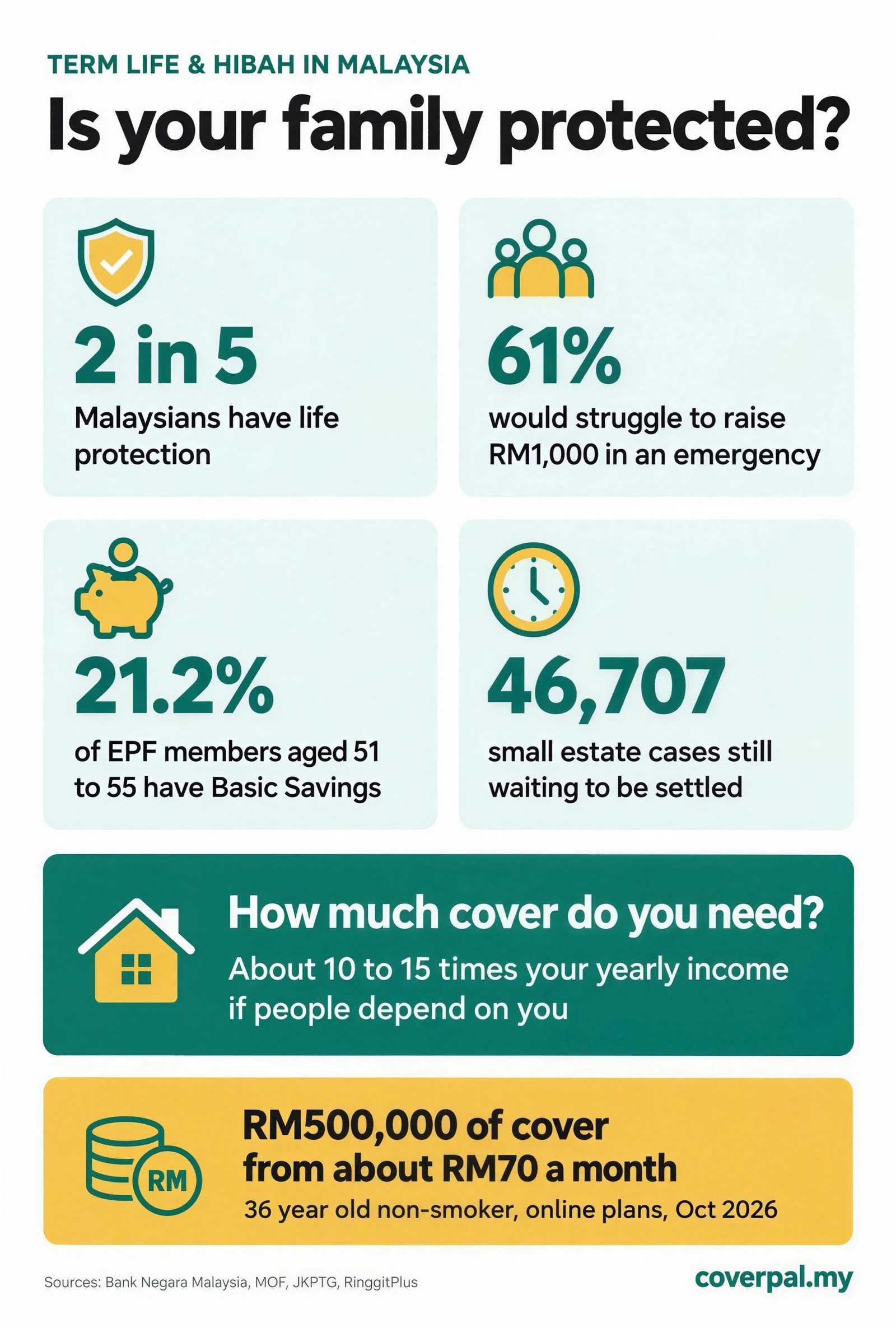
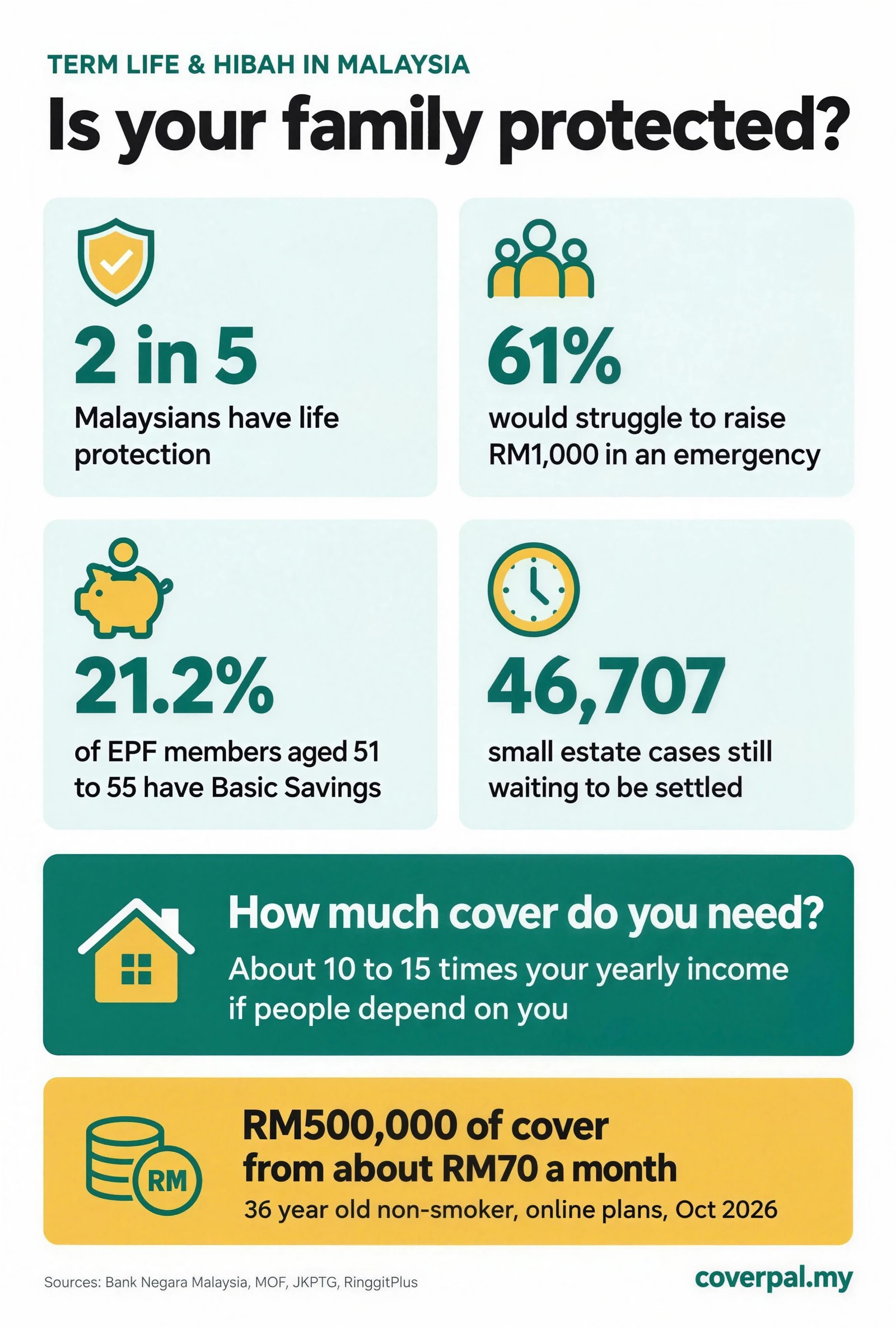
These come from different reports and years, but the picture is clear. Only about two in five of us have any life cover [1]. LIAM, the life insurance association, says that once you strip out people who hold more than one policy, real coverage is only in the low 40s percent, and nearly half of people with dependants have no life insurance whatsoever [2].
Our savings are thinner than we think
Some people tell me, “Takpe, I have EPF. My family will get that.” Fair enough, your EPF does go to your nominee when they make a claim (for Muslim members, the nominee manages the savings on behalf of the rightful beneficiaries). Then there’s the question of how much is actually in there.
As at August 2025, only 21.2% of EPF members aged 51 to 55 had reached Basic Savings, the amount EPF says you need for a simple retirement [4]. And when the Deputy Finance Minister broke it down for members aged 54 back in 2023, 35% had less than RM10,000 in their account [5]. That’s at 54, almost the finish line.
Now think about a 35 year old. Even with a decent salary, the EPF balance at that age is usually a fraction of what it will be at 55. It was never meant to replace 20 years of your income.
EPF members aged 54, by savings (January 2023)
Share of members in each band. More than half had under RM50,000.
Source [5]
Then there’s debt. In the first half of 2025, Malaysia’s household debt was about 84.8% of GDP [6]. Most of that is housing loans and car loans, the exact things that don’t magically disappear when the main earner passes on. And remember the stat above? 61% of us would struggle to find RM1,000 for an emergency [3]. A funeral alone can cost more than that.

What really happens to the family left behind
I don’t want to be dramatic, but let’s be honest about the first few months, because this is where a lot of families get hit the hardest.
The funeral comes first
A Muslim burial typically costs around RM2,000 to RM5,000. A traditional Chinese funeral can run RM10,000 to RM30,000 or more, especially if you need a burial plot in the city, and a Hindu funeral is often RM5,000 to RM15,000 [7]. Family and friends help, of course, but somebody still has to pay upfront.
Then the money gets stuck
Here’s the part many people don’t know. When someone dies, their assets don’t just flow to the family the next day. Bank accounts, property and investments go through the estate process first. At the end of 2025 there were still 46,707 small estate cases waiting to be settled, even though the standard for a clean, undisputed case is about four months [11]. Lawyers estimate there’s something like RM90 billion in frozen or unclaimed inheritance sitting in Malaysia [10]. It’s an estimate, but even half of that is a crazy amount of money that families can’t touch.
Even insurance money goes unclaimed. In June 2026, Bank Negara launched a portal to help families find death benefits after the industry estimated that around 50,000 policies and certificates had payouts nobody claimed [12]. Usually because the family didn’t even know the policy existed.
The bills arrive long before the estate is settled. Having money the family can actually reach matters.
So what does term life or hibah actually do?
Okay, enough doom. Here’s the good part. Term life insurance (or term takaful, if you prefer a Shariah compliant plan) gives you cover for a set period, usually with no savings part attached. Hibah is a gift arrangement, and in family takaful it’s how you nominate who receives the payout. Here’s how the cover works:
- You pick an amount of cover, say RM500,000.
- You pay a yearly or monthly premium (called a contribution for takaful).
- If you pass away during the cover period and the claim is approved, your family receives that lump sum. Some plans also pay out if you become totally and permanently disabled, which matters just as much, because a disabled breadwinner stops earning too. Definitions and age limits for disability cover differ between plans, so check yours.
- If nothing happens, the cover simply ends. No savings element, no investment, no surrender value.
Leaving out the savings part is what helps keep the price down. You’re paying purely for protection, so the money isn’t being split into a savings or investment portion. There are still admin and distribution costs, just fewer moving parts. It’s the closest thing to “just insure me, boss”.
Where hibah comes in
For Muslim families, there’s an extra benefit worth knowing about. With family takaful, you can nominate your beneficiary under conditional hibah. In simple terms, the payout becomes a gift to the person you named. Under the Islamic Financial Services Act, that money doesn’t form part of your estate, isn’t used to settle your debts, and isn’t divided by faraid [9]. It goes straight to your nominee.
That’s a big deal when you remember how long estates can take. One takaful operator says hibah claims are typically paid within about 14 working days once documents are complete, compared with possibly years for assets without a nomination [13]. Every operator has its own process, but the principle is the same: a valid hibah nomination can skip the estate queue. The operator still has to assess the claim, so timing varies.
How much cover do you actually need?
This is the question everyone asks, and the honest answer is, it depends on your life. But you need somewhere to start, so here are two ways to think about it.
The quick rule of thumb
A common guide is to aim for cover of around 10 to 15 times your annual income if people depend on you [8]. For Faizal, earning RM72,000 a year, that’s roughly RM720,000 to RM1.08 million. Sounds like a lot? It’s really just his salary for the next 10 to 15 years, which is exactly what his family would lose.
The more accurate way: add it up
- Loans and commitments that would hit your household. Outstanding home loan, car loan, personal loans, credit cards.
- Living costs until the kids are independent. Monthly household spending times the number of years until your youngest finishes school or university.
- Big goals you want protected. University fees, your spouse’s retirement top up, maybe Hajj.
- Minus what you already have. EPF, savings, and any existing life cover, including group cover from your employer (which usually stops when you leave the job).
If that sounds like too much homework, no stress. Our financial score calculator walks you through exactly this in about five minutes and shows the gap in ringgit, using the same engine we use for our recommendations.
How much does it cost? Less than your Netflix plus Grab Food
This is where most people are surprised. Because term life is pure protection, it’s cheap, especially if you buy it when you’re young and healthy and you buy it direct.
When we checked in October 2026, a 36 year old man who doesn’t smoke could get RM500,000 of cover from around RM790 a year (RM70 a month if paid monthly) with Sun Life’s Sun eSsential Life, a step up plan that runs to age 80. Among level plans, where the price stays fixed for the term, Kaotim Legasi started from around RM960 a year for a 10 year term. Exact prices depend on your age, gender, smoking status and health, and the insurer confirms your final price after a few health questions.
RM70 a month. That’s roughly two Grab Food orders and a streaming subscription. For half a million ringgit going to your family if the worst happens.

Level or step up? Know what you’re buying
One thing to watch. Some plans charge a level price that stays the same for the whole term, say 10, 20 or 30 years. Others charge a step up price that starts low and increases as you get older. Step up plans look cheaper on day one, while level plans can work out better if you plan to keep the cover for a long time. Neither is wrong, you just need to compare like with like. On CoverPal, the “What’s covered” box on every plan tells you which one it is, and the filters let you compare plans over the same cover period.
“Nanti dulu lah.” The excuses we all make
“I’m still young.”
Which is exactly why it’s cheap now. Your age and health on the day you apply set your price, and for level plans that price stays the same for the whole term. Applying older usually costs more, though the exact price depends on the plan and underwriting.
“My spouse also works.”
Great, that helps. But could your household keep up the home loan, the car and the kids’ expenses on one salary, while also grieving? If the honest answer is “very tight”, it’s worth working out the gap. It works both ways too: the lower earner often needs cover as well, because childcare and housework suddenly cost money.
“I’m single, no kids.”
Then maybe you need less. But think about your parents if you support them, any loans you took with family, and the disability side of the cover. A total and permanent disability payout is for you, the person still here.
“My company gives me insurance.”
Group cover is a nice bonus, but it usually stops the day you leave the job, and the amount is often a few times your salary, well below what your family would need. Treat it as extra on top of your own plan.
Getting started this week
Here’s a simple plan you can actually finish before the weekend:
- Work out roughly how much cover you need, with the rule of thumb or our calculator.
- Search term life and hibah plans for your age and amount. You’ll see insurance and takaful side by side, with yearly and monthly prices.
- Pick a plan, read its product disclosure sheet, and apply directly on the insurer’s or operator’s site.
- Name your nominee properly. For takaful, choose hibah if that’s what you want.
- Tell your spouse or family that the policy exists and where to find it. Don’t be one of the 50,000.
And if you’re worried about being on your own when it’s time to claim, that’s exactly why we built CoverPal Plus: a real person who helps your family with the paperwork, even for policies you bought elsewhere. It’s a paid service at RM50 a year, and the insurer or takaful operator still decides the claim.
Sources
- [1]Bank Negara Malaysia, speech by Deputy Governor Adnan Zaylani Mohamad Zahid, 28 August 2024. bnm.gov.my/en/-/dgaz-spch-liamspif
- [2]The Sun, LIAM President Raymond Lew on life insurance penetration and the 2022 survey, 28 August 2024. thesun.my/business/liam-launches-i-mula-50-to-make-life-insurance-more-accessible-ji12923479
- [3]Bernama, BNM Financial Capability and Inclusion Survey cited by Deputy Governor Adnan Zaylani, 17 November 2024. bernama.com/en/news.php?id=2364416
- [4]The Vibes, Ministry of Finance parliamentary reply on EPF Basic Savings (as at 31 August 2025), 8 October 2025. thevibes.com/articles/news/113744/majority-of-epf-members-fall-short-of-basic-retirement-savings-mof-acknowledges
- [5]Focus Malaysia, Deputy Finance Minister on EPF savings of members aged 54 (January 2023 data), 29 November 2023. focusmalaysia.my/?p=154222
- [6]Bank Negara Malaysia, Financial Stability Review first half 2025. bnm.gov.my/-/fsr25h1-pr
- [7]Free Malaysia Today, The importance of pre funeral planning in Malaysia, 19 August 2025. freemalaysiatoday.com/category/leisure/2025/08/19/the-importance-of-pre-funeral-planning-in-malaysia
- [8]RinggitPlus, How to choose the right life insurance policy, 9 February 2026. ringgitplus.com/en/blog/the-experts-corner/how-to-choose-the-right-life-insurance-policy.html
- [9]AZMI & Associates, nomination and hibah under the Islamic Financial Services Act 2013. azmilaw.com/insights/3016791
- [10]Utusan Malaysia, RM90b harta pusaka tak dituntut (estimate by Shariah lawyer Nurul Ai Li Baharuddin), 21 July 2025. utusan.com.my/ekonomi/2025/07/rm90b-harta-pusaka-tak-dituntut-ancam-ekonomi-domestik
- [11]New Straits Times, RM19b in small estate cases settled in 2025, 29 January 2026. nst.com.my/amp/news/nation/2026/01/1367280/rm19b-small-estate-cases-settled-2025-dewan-rakyat-told
- [12]New Straits Times, Bank Negara launches portal for beneficiaries to check unclaimed insurance, 26 June 2026. nst.com.my/amp/news/nation/2026/06/1473591/bank-negara-launches-portal-beneficiaries-check-unclaimed-insurance
- [13]PruBSN, The importance of naming a nominee for your takaful certificates. prubsn.com.my/en/takaful-articles/the-importance-of-naming-a-nominee-for-your-takaful-certificates
This article is general information, not financial advice. Figures were correct when we checked them on 4 October 2026. Always read the product disclosure sheet before you buy.

Khairul from CoverPal
· 11 min read