In this article
“Medical card? That’s for people with big salary lah. I’m young, I’m healthy, and if anything happens there’s always government hospital.” If you’ve ever said this, or heard your parents say it, this article is for you. Let’s look at what a hospital stay actually costs in Malaysia today, and why a medical card works a lot like a seatbelt. You hope you never need it, and you’re very glad it’s there when you do.
The myth: “I’m young, I don’t need it yet”
Most of us only start thinking about medical cover after something happens. A friend gets dengue and spends five days in a private hospital. An uncle needs a heart procedure. A colleague finds a lump. Suddenly everyone in the WhatsApp group is asking, “eh, which medical card is good ah?”
The problem is, by then it may be too late for that person. Medical cards are underwritten, which means the insurer asks about your health before accepting you. If you already have a condition, it can be excluded, or your application can be declined. Applying while you’re healthy gives you more options. Just make sure the benefits suit you and the premium is something you can keep paying.
And being young doesn’t mean you won’t need a hospital. Accidents, appendicitis, dengue, a slipped disc from badminton. Young people end up in hospital too.
What a private hospital stay really costs
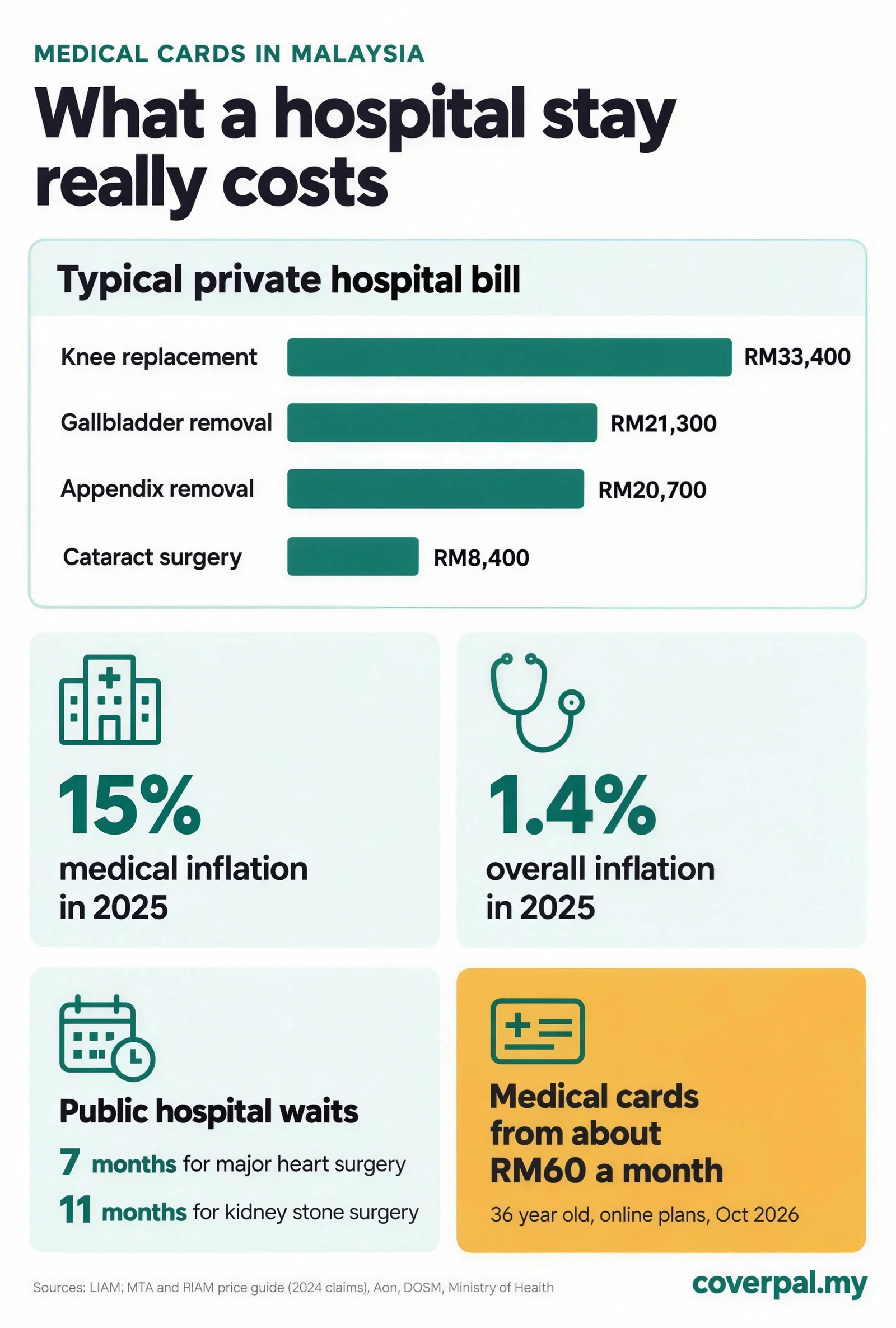
Good news: we no longer have to guess. In January 2026, the life, takaful and general insurance associations published a price guide based on actual 2024 claims from private hospitals [3]. Here are the typical bills (the median, so half of patients paid more) for some very common procedures:
Typical private hospital bill in Malaysia, by procedure
Median inpatient bill from 2024 claims data. Half of patients paid more than this.
Source [3]
RM20,700 for an appendix. Something that can happen to literally anyone, at any age, with almost no warning. Now ask yourself honestly: if that bill landed on you next month, could you pay it without touching your EPF, selling something, or borrowing from family?
And plenty of people pay from their own pocket. In the National Health and Morbidity Survey 2023, 54.8% reported using their own money to pay for inpatient care, while private insurance was used by only about 15% [10].
Let’s make it real with three very normal situations. These are illustrations, but the bills come straight from the industry price guide [3].
Scenario 1: Amir, 29, sudden stomach pain
Amir wakes up at 3am with pain on the right side of his stomach. By morning it’s appendicitis. Keyhole surgery, almost three days in a private hospital. Typical bill: RM20,700. With a medical card and cashless admission at a panel hospital, the hospital asks the insurer for approval and bills them directly. He may still pay a deposit or anything his plan doesn’t cover. Without one, that’s months of take home pay, gone in a weekend.
Scenario 2: Mei Ling, 41, gallstones
Mei Ling has been getting pain after meals for months. The doctor recommends removing her gallbladder. In the public system she can join the waiting list. In a private hospital it can be done much sooner, typical bill RM21,300. She runs a small online business, so every month she’s unwell is a month of lost sales.
Scenario 3: Encik Ravi, 63, cataracts
Ravi’s eyesight is getting cloudy and he’s stopped driving at night. Cataract surgery in a private hospital typically costs RM8,400 [3]. If his kids are the ones paying, that’s a big chunk of their savings too. Which is why getting your parents covered early, while they can still qualify, matters so much.
Bigger stuff costs a lot more. Private hospitals told the media that a heart bypass averages around RM70,000 to RM80,000, and can reach RM100,000 or more for minimally invasive surgery [12].
“Just go government hospital lah.” Can or not?
Let’s be fair here. Malaysia’s public hospitals are excellent value. The doctors and nurses are dedicated, the treatment is heavily subsidised, and for emergencies they are often the best place to be. Nobody is saying public healthcare is bad.
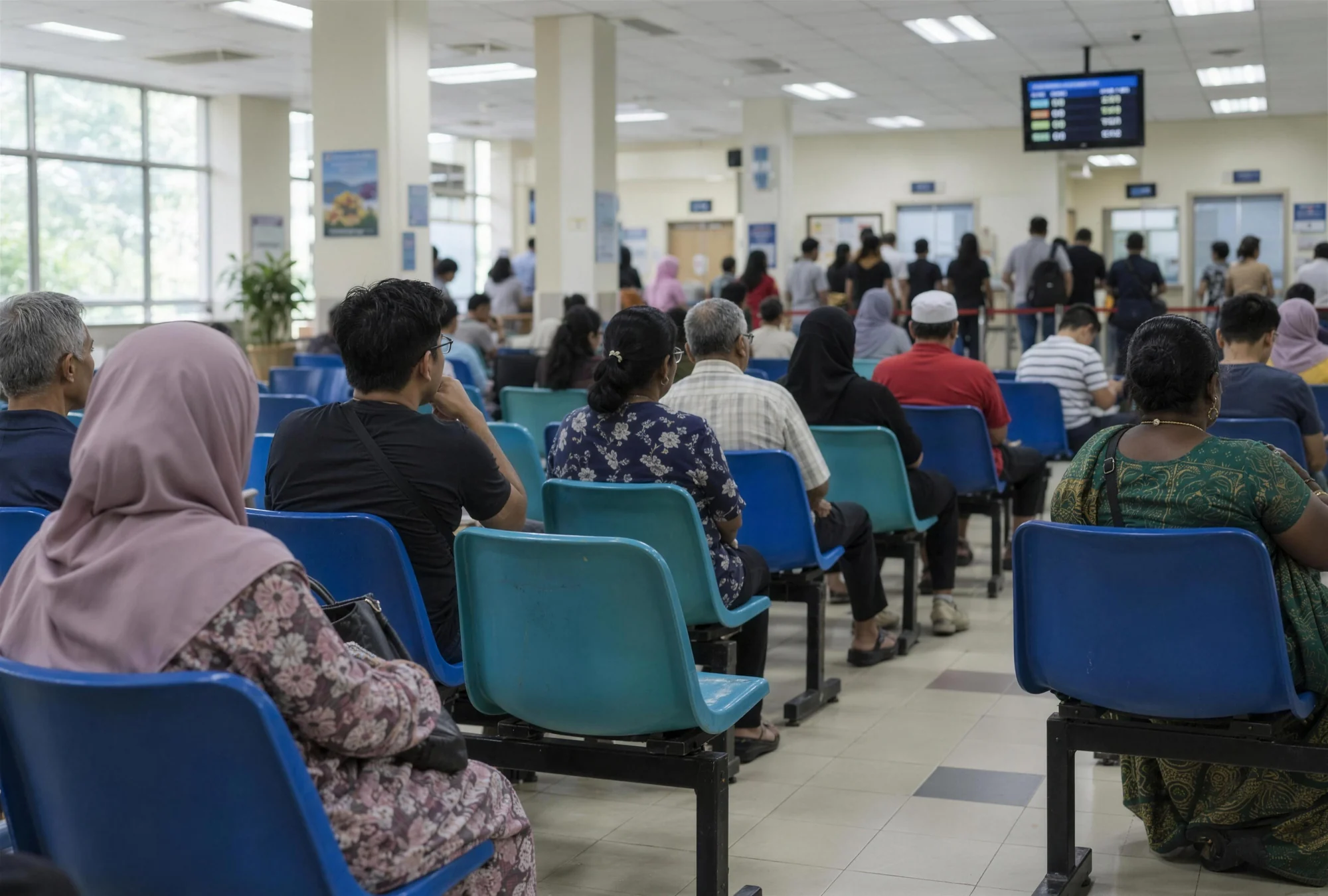
The issue is waiting time, especially for planned (elective) procedures. In July 2025, the Health Minister shared the waiting lists for elective surgery [4]:
Reported waits for selected public hospital procedures (2025 and 2026)
Part of the reason is a serious shortage of specialists. Ministry of Health data shows the public sector had only about 44% of the specialists it needs in 2025, and for cardiothoracic surgery it was just 18% [5]. That’s not anyone’s fault on the ground. There just aren’t enough hands.
So the real question is about time. When you need something done, can you afford to wait seven months? If you’re self employed, every week you can’t work is a week with no income. If you have kids, months of being in pain quickly becomes the whole family’s problem.
The cancer conversation we have to have
Malaysia recorded an estimated 54,586 new cancer cases in 2024 [7]. That’s about 150 families hearing the news every single day. And worse, 65.1% of cancers here are found at stage 3 or 4, when treatment is longer and more expensive [8].
What happens to money after a cancer diagnosis? A well known study by The George Institute followed cancer patients in Southeast Asia. In Malaysia, 45% faced financial catastrophe within a year, meaning their out of pocket costs ate up more than 30% of household income, and 46% used up their savings [9]. The study is from 2015, and costs have only gone up since. Some targeted cancer drugs cost RM6,000 or more every month, for years [14].
One hospital bill can eat the money you were saving for your kids and your retirement.
What rising medical costs mean for your budget
Here’s the number that should worry everyone. Medical costs in Malaysia rose about 15% in 2025, and are projected to rise 16% in 2026, according to Aon [1]. Compare that with general inflation of just 1.4% in 2025 [2]. Aon’s figure tracks the cost of employee medical plans, which is a different measure from consumer prices, but the gap tells you why healthcare deserves its own line in your budget.
How fast prices rose in Malaysia, 2025
Medical cost trend vs overall consumer prices
What does 15% a year do? Roughly speaking, a bill that costs RM20,000 today could cost about RM40,000 in five years if that pace holds. Your salary is not doubling in five years. Mine also not.
Yes, medical card premiums have gone up too, and many people got a shock when their plans were repriced in 2024. Bank Negara stepped in with interim measures, and by its own count more than 90% of policies repriced for medical inflation went up by less than 10% [13]. That helps, but it doesn’t mean your premium will stay cheap forever. Check how the price changes with age and future repricing before you commit.
So how much is a medical card, really?
Less than most people think, especially online. When we checked in October 2026, medical cards on CoverPal for a 36 year old man started from about RM655 a year (RM60.26 a month if paid monthly) with Takaful Malaysia’s Kaotim MediKad, at a RM50,000 yearly limit with no deductible. That’s about the price of one mamak dinner for the family each week, except it can save you RM20,000 when your appendix decides to give up.
Prices go up with age (medical cards are usually step up, meaning the price follows your age at each renewal), and depend on the annual limit you pick, the room and board amount, and whether you take a deductible.

How to choose a medical card without getting a headache
When you compare, these are the things that actually matter:
- Annual limit. The most the plan pays in a year. There’s no single right number. Look at the bills above, what you can afford now, and how the premium will change as you get older.
- Lifetime limit. Many newer plans have no lifetime limit, which is what you want for long illnesses like cancer.
- Deductible. An amount you pay first before the plan kicks in. A RM1,000 deductible lowers your premium, but you pay that RM1,000 per claim or per year. No deductible doesn’t mean you pay nothing, so also check copayments, exclusions and sublimits.
- Room and board. The daily room limit. Pick one that matches the hospitals near you.
- Cashless admission and panel hospitals. So you don’t need to pay first and claim later.
- Outpatient cancer treatment. Chemo and radiotherapy are often outpatient, so check this is covered.
- Waiting periods and exclusions. Most plans won’t pay for some illnesses in the first months, and existing conditions may be excluded. It’s all in the product disclosure sheet.
On CoverPal you can tick exactly these as must haves (no deductible, cashless admission, no lifetime limit, outpatient cancer) in the filters, and see every matching plan side by side, insurance and takaful together.
Start small if you have to
If budget is tight, a basic plan with a lower limit is far better than nothing. You can look at upgrading later, though that may need fresh underwriting. What you don’t want is to wait until there’s a diagnosis on your record.
“But my company already covers me”
Lucky you, and do use it. But there are a few things about group insurance from your employer that people only find out the hard way:
- It ends when the job ends. Resign, get retrenched, or start your own business, and the cover usually stops on your last day.
- The limits are often lower than they look. A yearly limit that sounds fine can disappear fast with one surgery at the prices above.
- Getting covered later gets harder. If you develop a condition while on group cover and then leave, a new personal plan may exclude it.
A personal medical card stays with you no matter where you work. Many people keep both: the company plan for everyday admissions, and their own card as the safety net.
Four mistakes we see all the time
- Waiting for a scare. The most common story. Someone gets a diagnosis, then tries to buy cover, and the condition is excluded.
- Not declaring things on the form. Always answer the health questions honestly. Leaving something out can give the insurer grounds to reject a claim later, exactly when you need it.
- Choosing only on price. The cheapest plan might have a big deductible or a low limit. Check what you’re giving up for that saving.
- Letting it lapse. Missed payments can end your cover, and coming back means new underwriting at an older age. Set up auto debit and forget about it.
The bottom line
Think of a medical card as the thing that stops one bad week in hospital from wiping out years of saving. And if you ever need help understanding your policy or making a claim, our CoverPal Plus team can walk you through it. It’s a paid service at RM50 a year, and your insurer still decides the claim.
Sources
- [1]Asia News Network, Malaysia’s medical inflation to rise to 16% in 2026 (Aon Global Medical Trend Rates Report, employee medical plan costs), October 2025. asianews.network/malaysias-medical-inflation-to-rise-to-16-in-2026-says-report
- [2]Department of Statistics Malaysia, Analysis of Annual Consumer Price Index 2025, 29 April 2026. dosm.gov.my/portal-main/release-content/analysis-of-annual-consumer-price-index-malaysia-2025
- [3]LIAM, MTA and PIAM, Price ranges of common private healthcare services in Malaysia (2024 claims data), January 2026. liam.org.my/library/healthcare/Price-Ranges-Common-Private-Healthcare-Services-Msia_27Jan2026.pdf
- [4]The Star, Push to reduce wait times (Health Minister on elective surgery waiting lists), 24 July 2025. thestar.com.my/news/nation/2025/07/24/push-to-reduce-wait-times
- [5]CodeBlue, Public sector short of nearly 11,000 specialist doctors (MOH data), 7 July 2025. codeblue.galencentre.org/2025/07/public-sector-short-of-nearly-11000-specialist-doctors-moh-data
- [6]CodeBlue, Non cancer elective surgery waiting time up to 13 months in MOH, 22 July 2026. codeblue.galencentre.org/2026/07/non-cancer-elective-surgery-waiting-time-up-to-13-months-in-moh
- [7]International Agency for Research on Cancer, GLOBOCAN Malaysia fact sheet. gco.iarc.who.int/media/globocan/factsheets/populations/458-malaysia-fact-sheet.pdf
- [8]New Straits Times, Late stage cancer cases rise in Malaysia (National Cancer Registry Report 2017 to 2021), July 2024. nst.com.my/amp/news/nation/2024/07/1078584/late-stage-cancer-cases-rise-malaysia
- [9]AIA Malaysia press release on the ACTION study by The George Institute, 2015. aia.com.my/bm/about-aia/media-centre/press-release/2015/Close-to-50Percent-of-Cancer-Patients-in-Malaysia-Experience-Financial-Catastrophe.html
- [10]CodeBlue, Some Malaysians still can’t afford health care (NHMS 2023), 14 June 2024. codeblue.galencentre.org/2024/06/some-malaysians-still-cant-afford-health-care-nhms-2023
- [11]Ministry of Finance, press release on MediAsas, July 2026. mof.gov.my/portal/en/news/press-release/press-release-jbmkks-mediasas-060726
- [12]CodeBlue, Base MHIT’s RM100k cover likely insufficient for major heart surgery (APHM), January 2026. codeblue.galencentre.org/2026/01/base-mhits-rm100k-cover-likely-insufficient-for-major-heart-surgery-aphm
- [13]Bank Negara Malaysia, Annual Report 2025. bnm.gov.my/publications/ar2025/ch1c
- [14]CodeBlue, The alarming gap in financing cancer treatments, 6 October 2022. codeblue.galencentre.org/2022/10/the-alarming-gap-in-financing-cancer-treatments-sew-boon-lui
This article is general information, not financial advice. Figures were correct when we checked them on 3 October 2026. Always read the product disclosure sheet before you buy.

Khairul from CoverPal
· 12 min read