In this article
We book flights on our phone. We renew road tax online, pay bills with DuitNow, buy groceries from an app and file our taxes online with LHDN. But when it comes to insurance, many of us still wait for “someone” to come and explain it. Fair enough if you want the help. But it’s worth checking what buying direct would cost before you decide.
We already do everything else ourselves
Malaysians are some of the most online people in the region. In 2024, 98% of us used the internet [6], and Bank Negara says 92% now use digital financial services [7]. Your mak cik probably transfers money with her phone faster than you.
So why does insurance still feel like it needs a middleman? Partly habit. Partly because insurance used to be genuinely complicated to buy. And partly because, for a long time, there just wasn’t another way. That changed quite a while ago, actually. Many of us just haven’t come across the direct plans yet.
Where does your premium actually go?
When you buy a policy through an agent or another intermediary, part of what you pay goes to them as commission. Fair enough, agents do real work. A good agent explains the policy and can help with servicing and claim paperwork, though it depends on the agent. Still, it’s worth knowing how big that slice can be.
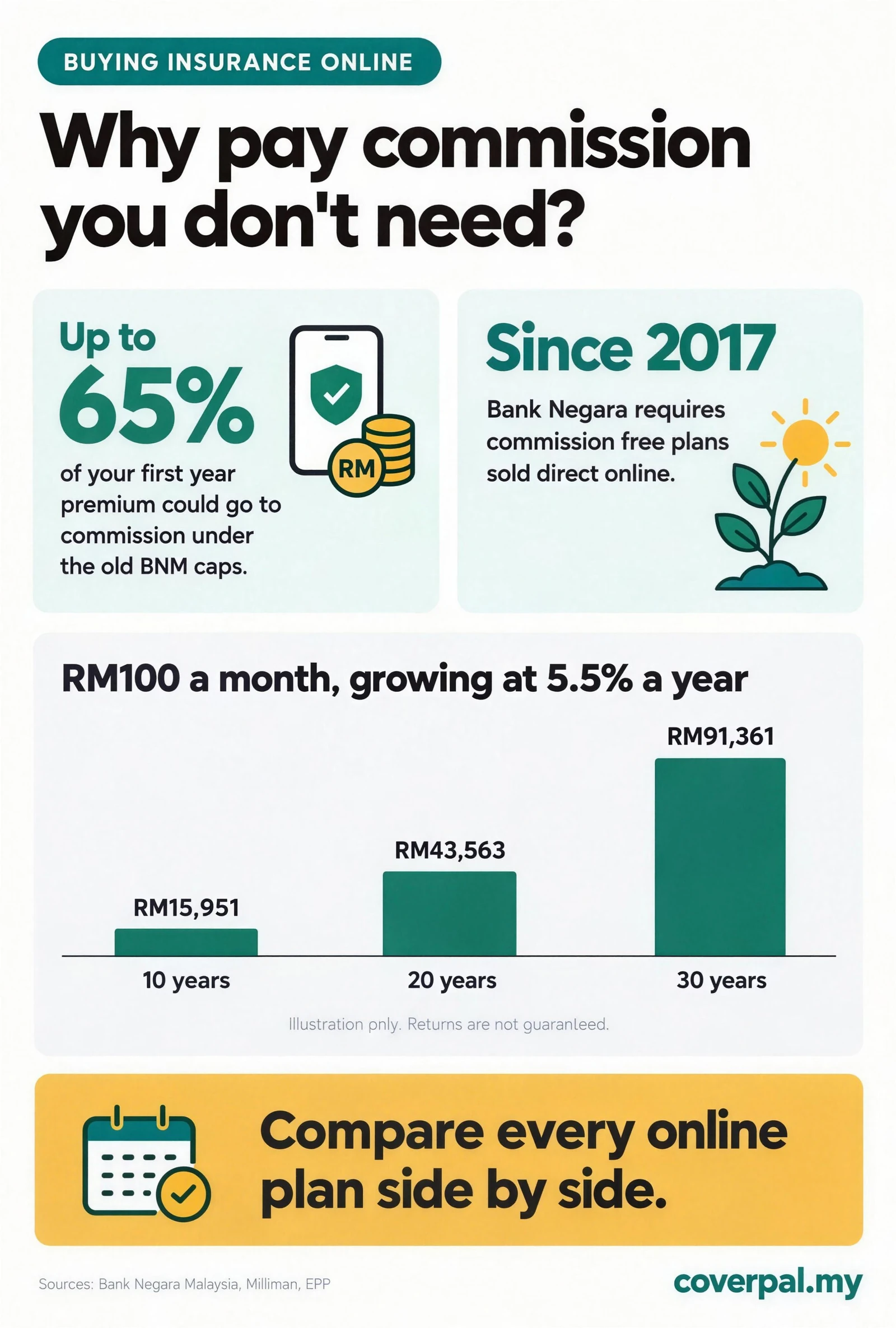
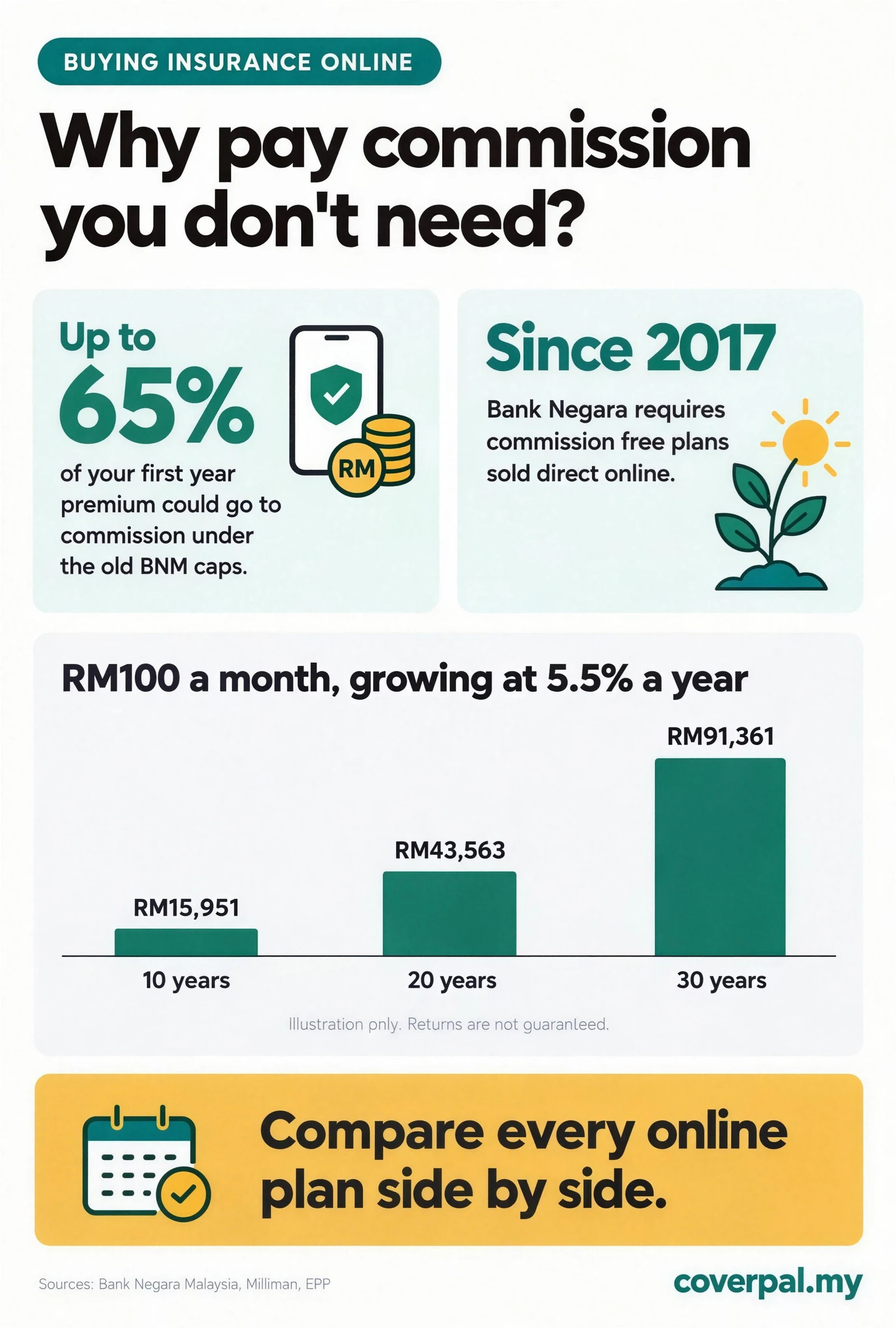
Under Bank Negara’s older cost controls, commission on a regular premium life policy of 20 years or more could be up to 65% of your first year’s premium, then 40% in the second year and 26% in the third [2]. Industry commentary has also put agent commissions at up to 40% of premiums during the first six years of a typical life policy [3]. Back in 2015, total agent pay in the life insurance industry came to RM3.9 billion, about 13% of net premiums [5].
Think about it like buying a phone. You can buy it at a shop in the mall, with the rent, the staff and the nice lighting built into the price, or you can buy the exact same model from the brand’s official online store. Insurance needs a closer look than a phone, though, because plans from the same company can have different benefits and renewal terms. With insurance, the extra cost is mostly commission, and it’s usually heaviest in the first few years, which is exactly when you’re deciding whether to keep the policy.
Commission is one of the costs inside the price. Compare the benefits and premiums, then decide if the service is worth it to you.
The online option Bank Negara created
Here’s the part most people don’t know. Since 1 July 2017, Bank Negara has required life insurers and family takaful operators to offer commission free pure protection plans through at least one direct channel, such as their website [1]. Term life came first, then critical illness and medical plans from July 2018. For those direct pure protection products, no commission can be built into the price. Other products sold online can follow different rules.
Often it’s the same insurer and the same regulator, though the policy terms can differ. The difference is you apply yourself, so nobody needs to be paid for selling it to you.
So how much cheaper is it?
It depends on the plan, your age and what you compare it with. Analysts estimated back in 2013 that commission free direct plans would be about 20% to 30% cheaper than similar products sold through intermediaries [4]. In some cases the gap is much bigger, and at CoverPal we say buying online can be up to 70% cheaper, for selected comparisons. Taking out agent commission can reduce distribution costs, but the savings depend on the plans and benefits you compare. Your own number will depend on the exact plans you compare.

What could the savings become?
Okay, this is the fun part. Let’s say buying direct saves you RM100 a month. For a lot of households, RM100 a month makes a real difference.
Now, instead of letting that RM100 disappear into Shopee 11.11, you put it somewhere that grows. For this example we’ll use 5.5% a year, a bit below EPF’s 10 year average dividend of 5.88% (EPF paid 6.15% for 2025) [8]. Here’s what happens with monthly compounding:
RM100 a month, growing at 5.5% a year
Illustration only, compounded monthly. Past returns don’t guarantee future returns.
After 10 years, you’ve put in RM12,000 and it’s grown to about RM15,951. After 20 years, RM24,000 in becomes about RM43,563. Leave it for 30 years and your RM36,000 turns into roughly RM91,361. More than half of that is pure growth. That’s compounding: your returns start earning returns of their own.
Save RM200 a month instead and those numbers simply double: around RM87,000 after 20 years and about RM183,000 after 30. Same habit, same effort, just a bigger slice kept in your pocket.
Where to actually put the money
A few common ideas. Which one makes sense depends on your bills, your debts and when you’ll need the money:
- Emergency fund first. Aim for three to six months of expenses in an account you can reach quickly. Boring, but it’s what stops a car repair from turning into credit card debt.
- Top up your EPF. You can make voluntary contributions on top of what your employer pays, and it earns the same dividend as the rest of your account.
- ASB, if you’re eligible. It paid 5.75 sen per unit for 2025, a record RM10.4 billion in total [10].
- Long term investing. For money you won’t touch for ten years or more, a low cost diversified fund is worth learning about. Returns go up and down, so give it time.
The point is to give the money a job. Cash you can reach quickly is still useful for emergencies and upcoming bills. RM100 a month that compounds for 20 years becomes a real number.
Or, you know, live a little
Not everything has to be investing. Money you don’t overpay is money you get to decide about. It could be:
- A family trip to Langkawi or Japan every couple of years, without the credit card hangover.
- A faster down payment on your first home, or a bigger chunk off the housing loan.
- Paying off the car earlier so that monthly instalment finally disappears.
- An education fund for the kids, building quietly in the background.
- An emergency fund, so you’re not part of the 61% who’d struggle to find RM1,000 tomorrow.

What online prices look like right now
Talk is cheap, so here are real numbers. When we checked the plans on CoverPal in October 2026, for a 36 year old man who doesn’t smoke:
- RM500,000 of term life cover started from around RM790 a year, or RM70 a month if paid monthly (Sun eSsential Life, a step up plan to age 80).
- A medical card started from around RM655 a year, or RM60.26 a month (Kaotim MediKad, RM50,000 yearly limit, no deductible).
Your price will depend on your age, gender, health and the exact plan. But it gives you a feel for it: proper cover for about what many people spend on their phone bill and a couple of streaming apps.
Five things people believe about buying online
“Online policies are the cheap, cut down version”
Direct plans are real policies from licensed insurers and takaful operators, with their own product disclosure sheets and the same consumer protection as any other policy. The selling is what changes. Read the benefits properly, the same as you would for any plan.
“Claims get rejected more when you buy online”
The insurer assesses every claim against the policy terms and what you declared when you applied, whichever channel you used. The best way to protect your claim is simple: answer the health questions fully and honestly.
“It’s too complicated to do myself”
Most direct plans take one sitting. You enter your details, answer a handful of health questions, choose the amount and pay. If you can book a budget flight with all the add ons, you can do this.
“Online is always the cheapest”
Often, but not always. Compare carefully, because a step up plan can look cheap today and cost more over 20 years. That’s why we show level and step up clearly on every plan.
“Nobody will remind me to renew”
Auto debit helps you avoid missed payments, but do check that deductions go through and read your renewal notices. Your insurer will also send notices before the anniversary.
“But who will help me if I buy online?”
This is the number one worry, and it’s a fair one. Buying is the easy part. The hard part is years later, when something happens and you’re staring at a claim form at 2am, not sure what the insurer needs.
Two things to know. First, the insurer or takaful operator handles your claim either way. You didn’t buy a lesser policy just because you bought it online. Second, you don’t have to be alone. That’s the whole reason we built CoverPal Plus: a real person who helps you choose, explains your policy in plain words, and helps with the claim paperwork, even for policies you bought elsewhere. Plus is a paid service at RM50 a year, and the insurer or takaful operator still decides the claim.
How to buy online without getting lost
- Know what you need. Our financial score calculator shows your protection gap in ringgit in about five minutes.
- Compare properly. Search plans on CoverPal to see every online term life, medical, critical illness and cancer plan for your age, insurance and takaful side by side.
- Use the filters. Pick the same cover period, check level vs step up, and tick your must haves so you’re comparing like with like.
- Read the product disclosure sheet. Every plan has one. It’s shorter than you think.
- Apply on the insurer’s or takaful operator’s site. Answer the questions fully and honestly, then check your acceptance, cover start date and any waiting periods.
The final word
Some people genuinely want an agent beside them, and paying for that is a fair choice. We just think everyone should know the other option exists before they sign. Now you know. Same regulator, often the same insurer, and the price difference is yours to weigh against the help you get.
Sources
- [1]Bank Negara Malaysia, Direct distribution channels for pure protection products, policy document, 23 June 2017. bnm.gov.my/-/direct-distribution-channels-for-pure-protection-products-1
- [2]Asia Advisers Network, Milliman on Malaysia’s operating cost controls for life insurance commission, 24 August 2018. asiaadvisersnetwork.com/Article?aid=43933
- [3]RinggitPlus, Fi Life launches its own term life insurance, 9 February 2023. ringgitplus.com/en/blog/term-life-insurance/fi-life-launches-own-term-life-insurance-said-to-be-cheapest-for-women.html
- [4]Borneo Post, New BNM proposals to boost insurance sector growth (RHB Research estimate), 19 November 2013. theborneopost.com/2013/11/19/new-bnm-proposals-to-boost-insurance-sector-growth
- [5]The Edge Malaysia, Liberalisation and consumer demands spur changes in insurance companies, May 2016. theedgemalaysia.com/article/special-report-liberalisation-and-consumer-demands-spur-changes-insurance-companies
- [6]Department of Statistics Malaysia, ICT Use and Access by Individuals and Households Survey Report 2024. dosm.gov.my/portal-main/release-content/ict-use-and-access-by-individuals-and-households-survey-report-2024
- [7]Bank Negara Malaysia, Annual Report 2025. bnm.gov.my/publications/ar2025/ch1c
- [8]RinggitPlus, EPF declares 6.15% dividend for 2025. ringgitplus.com/en/blog/personal-finance-news/epf-declares-6-15-dividend-for-2025.html
- [9]The Edge Malaysia, Not all insurance products are cheaper online, says Neoh, 2 October 2017. theedgemalaysia.com/article/insurance-not-all-insurance-products-are-cheaper-online-says-neoh
- [10]New Straits Times, ASB dividend payment hits all time high of RM10.4bil, 19 December 2025. nst.com.my/amp/business/corporate/2025/12/1340981/asb-dividend-payment-hits-all-time-high-rm104bil
This article is general information, not financial advice. Figures were correct when we checked them on 2 October 2026. Always read the product disclosure sheet before you buy.

Khairul from CoverPal
· 11 min read