In this article
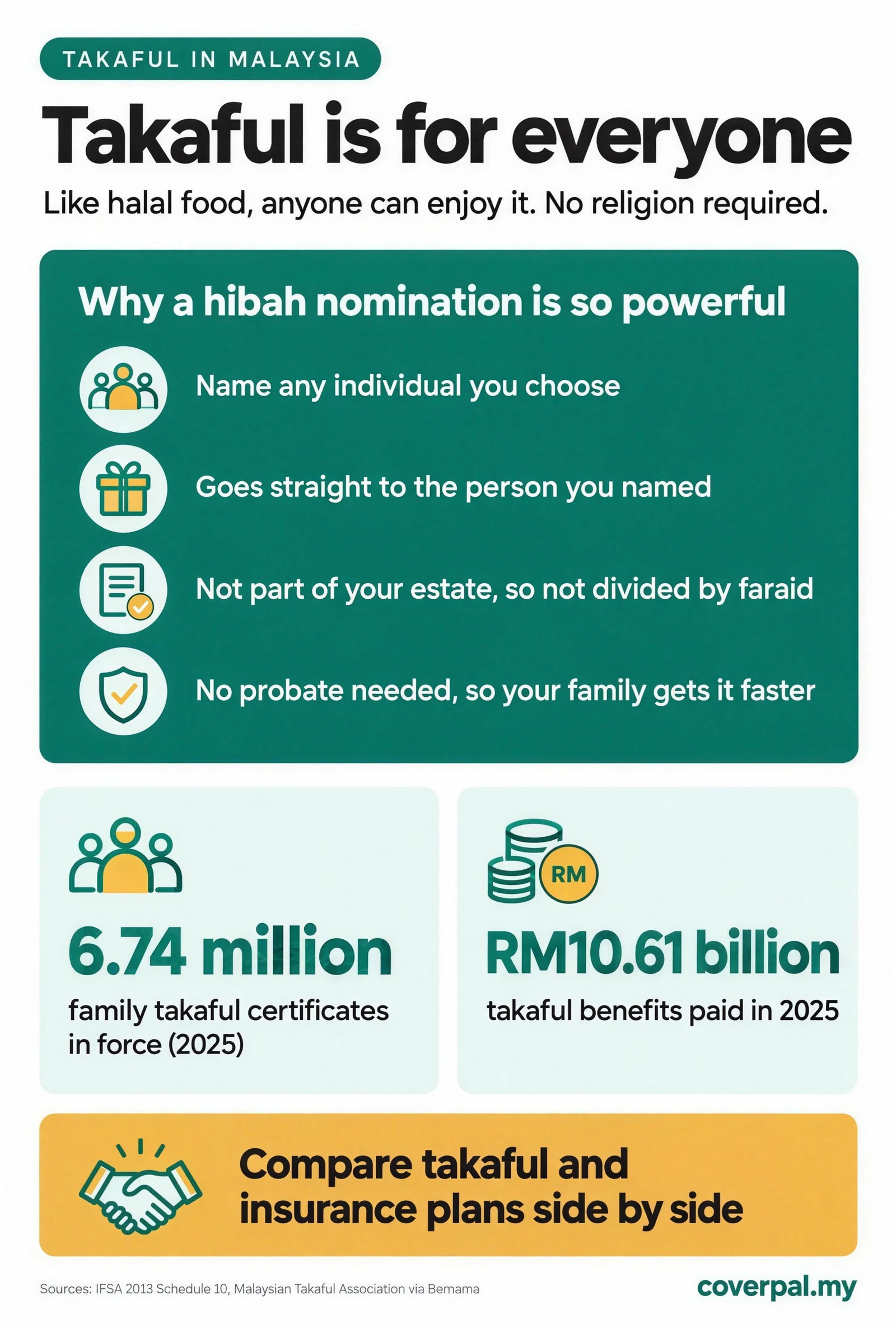
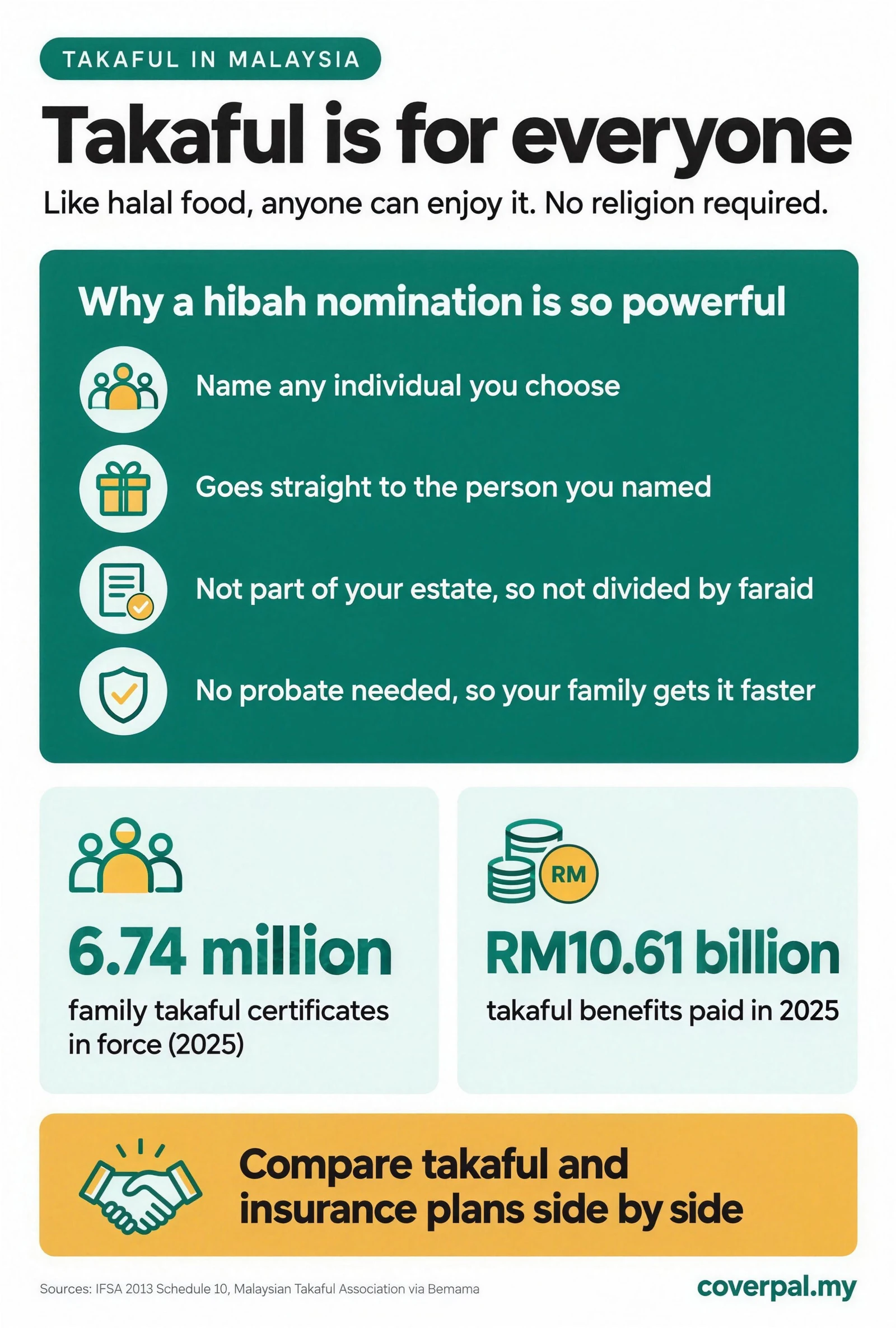
Quick question. When was the last time you checked for a halal logo before ordering nasi lemak, roti canai or that KFC bucket? If you’re not Muslim, probably never. You just eat. Halal food is food for everyone, and nobody thinks twice. Takaful is exactly the same, but somehow a lot of us still think it’s “for Malays only”.
Where the “Muslims only” idea comes from
Honestly, it’s an easy mistake. The word sounds Arabic, the products often have names like “Hayat” or “Murni”, and the brochures talk about Shariah, tabarru’ and wakalah. With all those unfamiliar words, it’s easy to assume it’s not meant for you.
Even Bank Negara has called this out. Back in 2018, the Governor said many non Muslims still see takaful as only for Muslims, called that a misperception the industry had to fix, and said family takaful should be “a trusted and valued solution provider for all Malaysians” [1].
So let’s fix it properly. Takaful has no religion requirement. Muslims and non Muslims can both apply, and acceptance and claims follow the plan’s own rules, same as insurance. It also comes with a nomination option worth knowing about, especially if you want to leave money to a sibling or a friend. We’ll get to that. First, what is it actually?
Takaful in plain words
The law defines takaful as an arrangement based on mutual assistance, where participants contribute to a common fund that pays out to members or their beneficiaries when certain events happen [2]. In normal language: a group of people chip in, and the pot helps whoever gets hit.
- Your contribution goes into a shared risk fund. Under the tabarru’ (donation) concept, that fund is owned collectively by all the participants, and claims are paid from it [3].
- The operator runs it for a fee. The takaful operator manages the fund and charges a wakalah fee, mainly for commissions and running costs, and Bank Negara requires any profit margin in that fee to be reasonable [3].
- Leftover money can come back to you. If the fund has a surplus after claims and reserves, it can be shared with participants. Bank Negara’s Shariah Advisory Council has ruled that this is permissible [4]. In 2025 alone, the industry distributed RM1.30 billion in surplus and benefits to eligible participants [6].
- Shariah oversight is built in. Takaful follows rulings of the Shariah Advisory Council of Bank Negara, the highest Shariah authority for Islamic finance in Malaysia [5]. It’s also licensed and supervised by Bank Negara, same as insurance.
From your side as a participant, it feels much the same as buying insurance. You choose the cover, pay the contribution (that’s what the premium is called), and your family claims if something happens.
Takaful in Malaysia, 2025
So who can participate in takaful? Everyone
There’s no religion box that decides whether you can join. Operators say it plainly too: takaful is open to non Muslims who want to subscribe and receive its benefits [8]. And non Muslims have been participating in takaful for a long time. As far back as 2008, one big takaful operator said 34% of its certificate holders were non Muslims [9]. That’s an old figure from one company, but it shows this isn’t new.
On CoverPal, 25 of the 55 online plans we list are takaful, from 9 takaful operators, across term life, medical cards, critical illness and cancer. Prices sit right alongside insurance too. When we checked in October 2026, for a 36 year old man who doesn’t smoke, RM500,000 of cover with Sun Life Takaful’s Sun eSsential-i started from about RM875 a year, while the conventional plan from the same group, Sun eSsential Life, started from about RM790. Same ballpark, with the takaful plan about RM85 more a year in this example. Both renew yearly and get pricier at older ages, so compare the benefits, exclusions and renewal prices, then pick what suits you.

Hibah: who gets the money when you’re gone?
Say you want your younger sister to get the payout because she’s the one looking after your mum. Can you arrange that? With takaful, yes, and that’s where hibah comes in.
With family takaful, you can nominate someone as a beneficiary under conditional hibah. Hibah means a gift. The rules sit in Schedule 10 of the Islamic Financial Services Act 2013, and they’re strong [2]:
- You can name any individual. Any participant aged 16 and above can nominate “an individual” as a hibah beneficiary. The law doesn’t ask about religion or relationship. Your spouse, your kids, your mum, your sister, your best friend. One operator’s guide says it directly: the beneficiary “need not be related to you by blood” [10].
- It goes straight to that person. When you pass away, ownership of the takaful benefit transfers to your hibah nominee “notwithstanding any written law” [2]. If the nominee is under 18, the law has the money paid to a parent or another authorised person to manage for them.
- It’s not part of your estate. The law says the benefit does not form part of your estate and is not subject to your debts, apart from a creditor fraud exception we’ll cover below. It isn’t distributed under faraid or your will [2].
- A will can’t override it. You can change or cancel the nomination while you’re alive by giving the operator written notice or making a new one. Your will can’t cancel it [2].
- No probate needed. With a nomination, the benefit can be paid without waiting for a grant of probate or letters of administration, which can otherwise take years [10]. And if an operator doesn’t pay a death claim within 60 days of being notified, paragraph 12 provides for compensation on the unpaid amount [2]. That’s a compensation rule, not a promise every claim is paid within 60 days.
You decide who gets the money. Nobody has to wait for the estate to be settled first.
And yes, this works for non Muslims too
Here’s the interesting bit. The hibah rules in the takaful law don’t split participants into Muslim and non Muslim at all [2]. Takaful operators’ own nomination forms include a hibah option for non Muslim participants too [12].
Compare that with conventional life insurance. Under the Financial Services Act, a non Muslim policy owner who names a spouse or child creates a trust for them (a parent qualifies only if there’s no living spouse or child at the time). Those trust benefits also stay outside the estate and away from your debts. But name anyone else, like a sibling or a close friend, and they receive the money as an executor, so it goes into your estate. Once a trust nomination is made, you also need the trustee’s written consent to cancel it or deal with the policy, such as surrendering it [11]. So the real difference with takaful hibah is choice: you can name whoever you want.
Picture Kumar, 42, single, looking after his elderly mother and close to his younger sister. With a takaful plan, he can split the payout between them as hibah, in whatever shares he wants. With a conventional policy, his sister would only get it as an executor, through the estate. Same goes for anyone who wants to look after a friend, a partner or a relative who isn’t a spouse, child or parent.

Can a hibah nomination be contested?
This is where people sometimes say “cannot be challenged, guaranteed”. Let’s be accurate, because it matters. A valid hibah nomination is protected by specific provisions in the law, which is why lawyers call it one of the strongest ways to pass on money. The law transfers the money “notwithstanding any written law”, and Schedule 10 overrides estate distribution laws, practice and custom [2]. In May 2026, a Syariah High Court in Taiping ruled that takaful hibah falls under the takaful contract law, outside the Syariah court’s jurisdiction, and dismissed the claim for lack of jurisdiction [13]. That ruling didn’t decide every possible challenge, but it shows where these disputes belong.
But it’s not magic. There was a well known 2025 dispute over a RM1 million takaful hibah paid to a widow, which went between the Syariah and civil courts, according to Bernama’s report [14]. A news report isn’t a settled rule for every case. Lawyers say a nomination can be challenged on grounds such as fraud or not following the nomination requirements [15]. And the law itself lets a creditor recover the contributions if a certificate was taken up to defraud them [2].
So use the operator’s nomination form, choose the hibah beneficiary option, get the right witness, and keep a copy. Jangan fill in, then leave it in the drawer.
Beneficiary or executor? Filling in the form properly
When you apply, the nomination form usually asks you to pick one of two roles for each person. This one small choice decides what happens to the money, so slow down here.
- Beneficiary under conditional hibah. The person receives the money as a gift for themselves. It stays outside your estate. This is the option most people mean when they say “hibah”.
- Executor. The person only collects the money and then distributes it according to your will or, for Muslims, faraid. It becomes part of your estate [2].
A few practical tips. You can name more than one person and set the shares yourself, say 60% to your spouse and 40% to your mum. If you don’t state shares, they’re split equally [2]. If you name a child below 18, the money is paid to a parent on their behalf, and if there’s no surviving parent, larger amounts go to the Public Trustee or a trust company to manage for the child [2]. Worth thinking about if you’re a single parent.
When the time comes, your nominee usually needs the death certificate, their own IC and the operator’s claim form. No grant of probate or letters of administration is needed for the nominated benefit [10]. Keep a copy of your certificate and nomination somewhere your family can find it, and tell the people you named. It sounds morbid, but it’s one of the kindest things you can do for them.
How to get takaful with a hibah nomination
- Work out how much cover you need. Our financial score calculator gives you an estimate based on your family and loans.
- Search term life and hibah plans on CoverPal, and tap Takaful to see only takaful plans, or compare them side by side with insurance.
- Apply directly on the takaful operator’s site and answer the health questions honestly.
- Fill in the nomination as beneficiary under conditional hibah, with the names and shares you want, and a witness aged 18 or above, of sound mind, who isn’t a nominee. Make sure the shares add up to 100%, submit the form and keep the operator’s acknowledgement.
- Tell the people you named, and review it after big life events like marriage, a new baby or a divorce.
Need help with the paperwork? CoverPal Plus is a paid helper service at RM50 a year. It explains your policy or certificate, helps you prepare nomination changes and claim paperwork, even for policies or certificates you took up elsewhere. It doesn’t pay or guarantee claims; the takaful operator decides.
Sources
- [1]Bank Negara Malaysia, speech by Governor Muhammad Ibrahim, Takaful industry at crossroads, 23 March 2018 (via BIS). bis.org/review/r180514b.pdf
- [2]Islamic Financial Services Act 2013, section 2 and Schedule 10 (Bank Negara Malaysia copy). bnm.gov.my/documents/20124/820862/Islamic+Financial+Services+Act+2013.pdf/8102422b-e6dd-d149-8db0-e3637e89ed5c?t=1584637168030
- [3]Bank Negara Malaysia, Takaful Operational Framework policy document, 26 June 2019. bnm.gov.my/documents/20124/948107/PD+TOF+26+June+2019.pdf/4ab1b034-3ea5-3ef2-d5aa-6f5b5d682fca?t=1594083517627
- [4]Bank Negara Malaysia, Shariah Advisory Council resolution on the distribution of surplus in takaful, 25 September 2007. bnm.gov.my/-/resolution-of-the-shariah-advisory-council-of-bank-negara-malaysia-on-the-distribution-of-surplus-in-takaful-scheme-and-the-application-of-wakalah-contract-in-deposit-instrument
- [5]Bank Negara Malaysia, Shariah Advisory Council. bnm.gov.my/shariah-advisory-council
- [6]Bernama, Malaysian Takaful Association 2025 industry figures, June 2026. bernamabiz.com/news.php?id=2567134
- [7]theSun, Malaysian takaful industry’s CAGR tops 10% over past decade (MTA chairman), 14 October 2025. thesun.my/business-news/malaysian-takaful-industry-s-cagr-tops-10-over-past-decade-more-than-double-that-of-conventional-sector-EN15097267
- [8]Prudential plc, How is takaful different from other insurance?. prudentialplc.com/en/newsroom/insights/how-is-takaful-different-from-other-insurance
- [9]Insurance Times, Pru’s takaful Malaysia growth (PruBSN certificate holders), 23 December 2008. insurancetimes.co.uk/prus-takaful-malasia-growth/1376074.article
- [10]Takaful Malaysia, Nomination Guide. takaful-malaysia.com.my/wp-content/uploads/2023/03/NominationGuide_Eng.pdf
- [11]Financial Services Act 2013, Schedule 10 (Bank Negara Malaysia copy). bnm.gov.my/documents/20124/820862/Financial+Services+Act+2013.pdf/35ed2b4c-1995-f91d-3891-75d69d247d55?t=1584637163610
- [12]Great Eastern Takaful, appointment and change of nominee form. greateasterntakaful.com/content/dam/corp-site/takaful/en/homepage/get-help/customer-service/appointment-changes-of-nominee.pdf
- [13]Utusan Malaysia, Hibah takaful: Mahkamah Syariah tiada bidang kuasa, May 2026. utusan.com.my/nasional/2026/05/hibah-takaful-mahkamah-syariah-tiada-bidang-kuasa
- [14]Bernama, RM1 million takaful hibah case, 18 July 2025. bernama.com/en/bfokus/news.php?id=2446578
- [15]Borneo Post, Validity based on law (hibah disputes), 3 August 2025. theborneopost.com/2025/08/03/validity-based-on-law
- [16]New Straits Times, Bank Negara launches portal for beneficiaries to check unclaimed insurance, 26 June 2026. nst.com.my/amp/news/nation/2026/06/1473591/bank-negara-launches-portal-beneficiaries-check-unclaimed-insurance
This article is general information, not financial advice. Figures were correct when we checked them on 4 October 2026. Always read the product disclosure sheet before you buy.

Azman from CoverPal
· 11 min read